Third Time Lucky in Paris: My Slowest Marathon and Greatest Victory
Two cancelled chances, pregnancy, a C-section and the road to my slowest, hardest and dearest marathon.
By Aleksandra Burkanović
Schneider Electric Marathon de Paris 2024
The 2024 Paris Marathon was my slowest, hardest and most emotional race, but it was also the one whose medal I had waited for the longest and carried home with the greatest pride. I reached it after two cancelled races, a pregnancy, a C-section, sleepless nights, training fitted around the needs of a small baby and a thousand moments when I wondered whether I was asking too much of myself.
If this story carries one lesson, it is that sometimes the slowest marathon says the most about how far we have come.
A dream that had to wait twice
Paris has always been my favourite city. Some cities are places you visit, explore and photograph, while others feel as if you have already lived another life in them; for me, Paris has always belonged to the second kind. After I ran my first marathon and fell in love with that inexplicable, brutal and beautiful distance, I knew that one day I would have to run Paris too. After all, how can you get to know a city more intimately than by moving through it on your own feet, without a bus window or a ready-made tourist route between you and its streets?
The first opportunity came in 2020, when I received an entry to the Paris Marathon as part of the ASICS FrontRunner team. I started training and could already picture the start on the Champs-Élysées, but then the pandemic happened and the world stopped, taking my race with it. The marathon was first postponed and then cancelled. Of course I was disappointed, but I believed it was only a delay and that sooner or later I would return to that dream.
Another opportunity appeared in 2022. I received an entry again, but then I became pregnant. This time there was no disappointment because something incomparably greater and more important was coming into my life. Still, somewhere in the back of my mind, I wondered whether Paris was trying to tell me something. Two opportunities, two major changes of plan - perhaps this marathon simply was not meant for me.
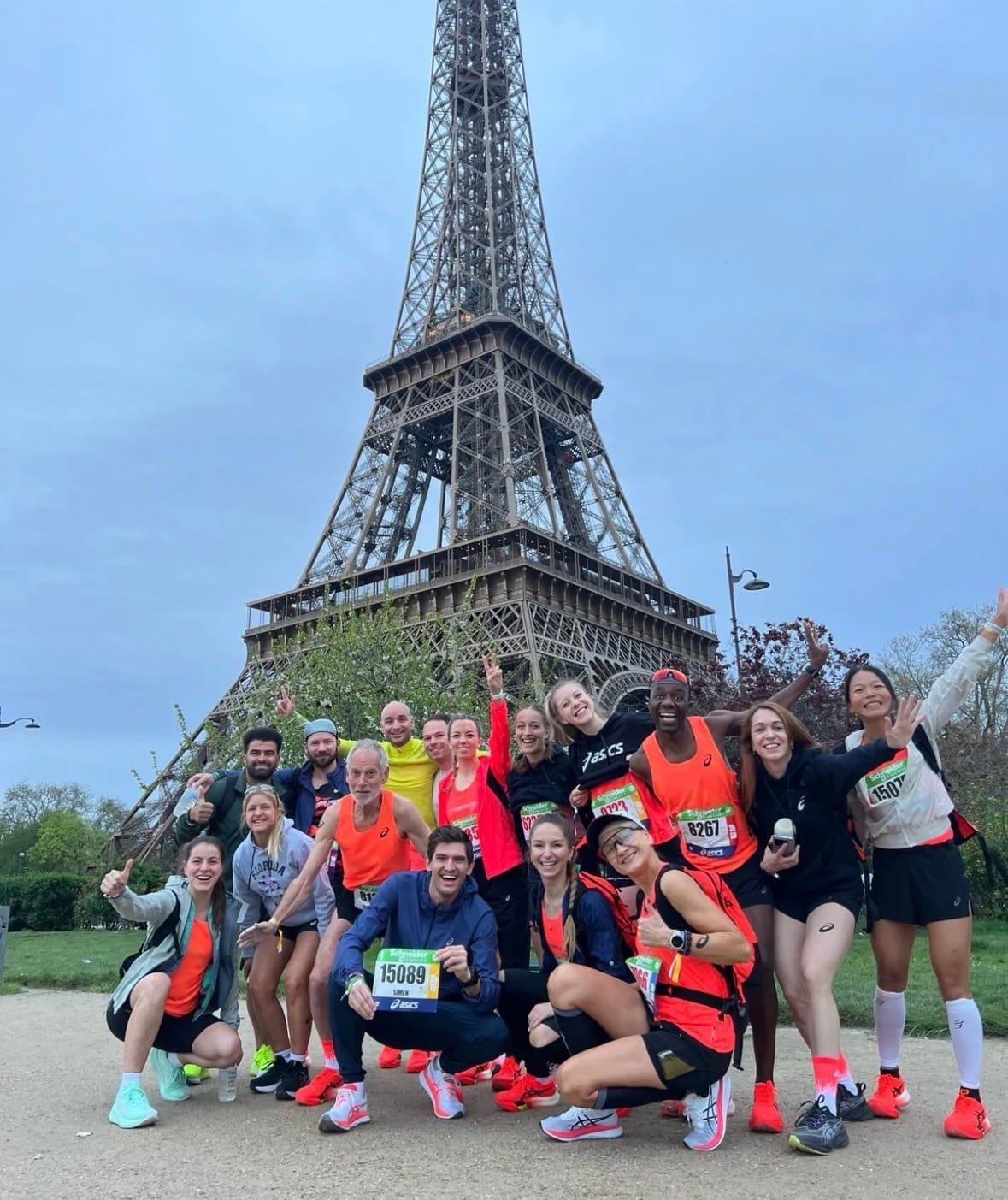
Then, in 2023, I became Jakov's mum and, in that most beautiful and demanding year of my life, a third opportunity arrived: an invitation to join a global ASICS gathering built around the 2024 Paris Marathon.
Third time lucky.
I told myself: You are going now, even if you have to run it on your eyelashes.
Wishes and the impossible
I wondered whether I was sane. Other people asked me too. How did I expect to prepare for and run a marathon one year after giving birth, especially after a C-section?
The honest answer is that I did not completely know how. I only knew that I wanted to try.
Of course, this is not a formula another woman should simply copy. Every postpartum recovery is different and every body has its own rhythm. For me, however, returning to running also meant returning to a familiar part of myself. I was not trying to break a record or pretend that nothing had changed. The goal was to finish, while my quiet, personal wish was to do it in under five hours.
Because I had previously run marathons between 3:16 and 3:40, I was convinced I could manage five hours even without serious training.
Right. How very wrong I was.
A marathon does not care who you used to be. It does not negotiate with old results or accept memories of former fitness in place of the kilometres you did not manage to run. You bring only what you have that day to the start: your present body, your present strength, your present life.
My life at the time was beautiful but completely unpredictable. Having a small baby while preparing for a marathon really is a little crazy. Recovery is often just a word other people say; you do not sleep enough, you do not always eat when you should, and you run when the baby allows it. During training, you are not thinking about the perfect pace or how good your legs feel. You are simply trying to finish because you need to hurry home. And when you return, almost everything you left behind is still waiting for you.
At a time like that, family support is not a nice extra but the foundation of the entire undertaking. A few hours someone gives you so that you can complete a long run mean much more than the training itself. They mean that someone believes in you, protects space for your dream and reminds you that becoming a mum did not stop you from being a person with wishes of your own. I owe my family an enormous thank you for that.
But let us be honest: the training was often pure torture. If I did not love the marathon so much, I would never do this to myself, I thought almost every time I left for a run. I believe runners will understand exactly that kind of love - the kind in which you regularly wonder why you need any of this, and then tie your laces and go out anyway.
As if the whole story were not uncertain enough, I became ill fifteen days before the marathon. I felt weak, I had not covered as many kilometres as I wanted, and my confidence was fading by the day. At one point I stopped thinking about pace, plans or results. I had only one goal left: to reach Paris.
The City of Light before dawn
I travelled to Paris with another friend from the ASICS team, happy, frightened and excited, with a million questions changing faster than the scenery outside the window. Can I do this? I have not run enough long runs. How will I last? What kind of mother leaves her baby to go and run a marathon? Is Jakov all right? Is it selfish of me to be here?
Motherhood can sometimes colour even the most beautiful personal moment with guilt. I was infinitely grateful to be moving towards my dream and sad to be away from my child for several days, both at the same time. It was already a true emotional roller coaster, and I had not even reached the start.
We arrived two days before the race, and ASICS had prepared a programme full of gatherings, events and running. It was wonderful, and the energy of people from different countries was infectious, but those days also meant many steps and little sleep - exactly what you are usually advised to avoid before a marathon.
Then 7 April 2024 dawned.
We got up while the city was still dark and started walking towards the start. I did not know then that we would walk around four kilometres to reach it or that I would cover almost another two while looking for my wave. Fear, nerves and excitement kept me from feeling tired. As we approached the Champs-Élysées, it seemed as though there were a million people around me.
I was not far from the truth: more than 53,000 runners reached the finish that year, making the 2024 edition one of the largest marathon gatherings in the world. The modern Paris Marathon has been held since 1976.
I waited in the start area for more than an hour and a half. Music, euphoria, warm-ups, hugs, nervous laughter and final checks of watches and laces surrounded me. I had already been awake for more than five hours and covered over six kilometres, yet the race had not even begun. My body seemed not to exist. There was only one thought following me when we finally set off: Hey, I am running the Paris Marathon. Finally!
The most beautiful postcard - and nothing like an easy one
The first few kilometres down the Champs-Élysées carry you along even when you want to slow down. The avenue is closed for runners, Place de la Concorde opens in front of you, and then you pass the Louvre through a city you may have seen in photographs many times, except now the entire postcard has become your course. The feeling is difficult to describe: it is as if Paris has handed you the keys to its streets for a few hours and told you to get to know it in the hardest way possible.
The route continues past Place de la Bastille towards the eastern part of the city and into Bois de Vincennes, an enormous park I saw for the first time that day and absolutely loved. The Paris Marathon is also fascinating because one race connects the city's two great green lungs - Bois de Vincennes in the east and Bois de Boulogne in the west - while threading runners between them past some of the world's most famous sights.
It sounds like perfect sightseeing. Except it lasts 42.195 kilometres, contains more rolling sections, flyovers and tunnels than photographs reveal, and is nowhere near as easy as the beauty of the course might lead you to believe.
Within the first few kilometres I already knew that a difficult day lay ahead. My body and mind were not cooperating, but the adrenaline did its work, the atmosphere carried me, and I started faster than I should have.
A mistake.
That classic marathon mistake you recognise the moment you make it, even though the bill arrives much later.
Somehow I held on until halfway. There were constantly so many people around me, spectators lined almost the entire course, bands played, and strangers called our names and encouraged us as though they knew exactly how much we needed it. But when we returned towards the centre and emerged onto the banks of the Seine, my body began to shut down.
For the first time in my life, I stopped while taking a gel. I walked perhaps fifty metres, confused by what was happening and frightened by the question of how I would reach kilometre 42 if I already felt like this.
My head became more crowded than the course. How will I do this? Why did I need this? Am I sane? Is Jakov all right? Why am I running a marathon when I could be at home with him?
The questions circled, but I kept moving. Sometimes I ran, sometimes I slowed, and sometimes I simply followed the backs of the people ahead of me. I could see that others were struggling too, and it is strange how much comfort you can find in knowing that you are not the only one falling apart. My legs were no longer carrying me as much as the people, the music and the city were.
The Seine
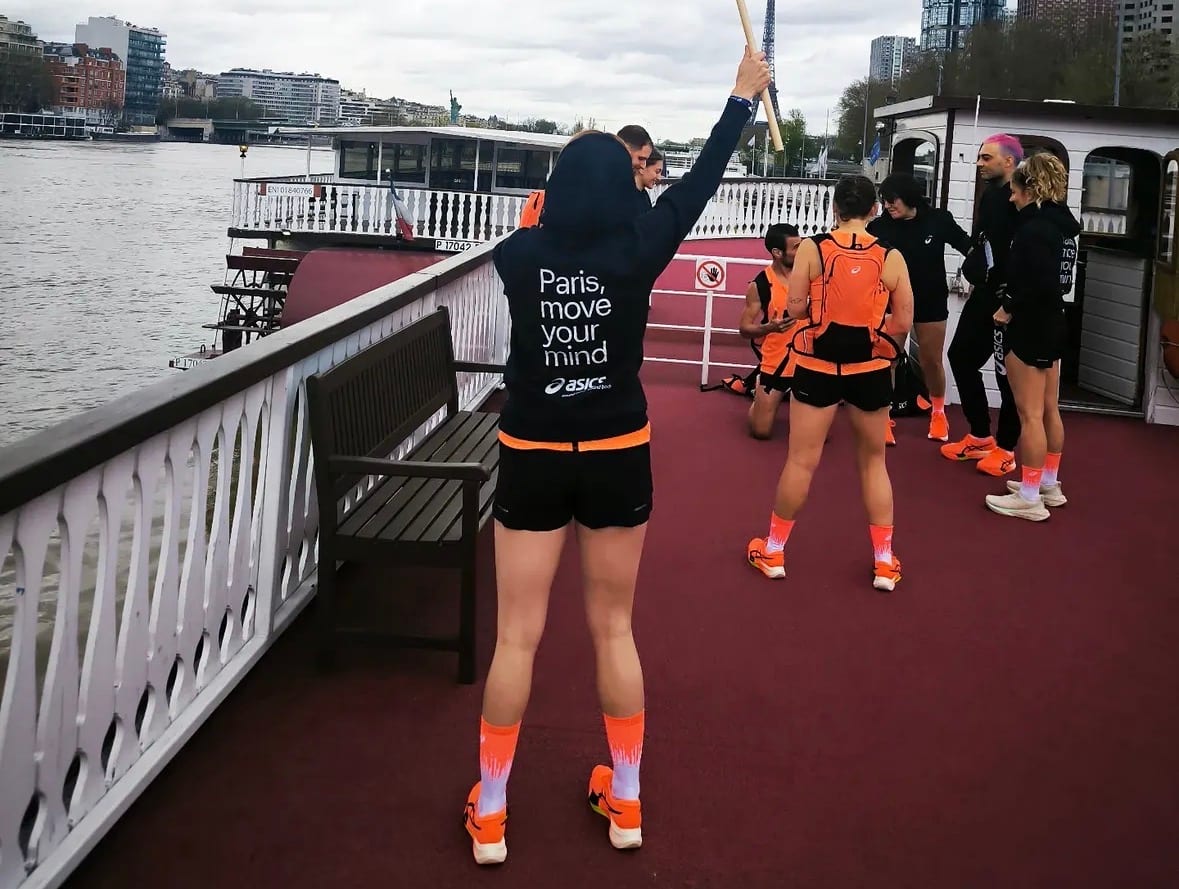
Somewhere between kilometres 30 and 35, when the marathon begins to strip away every layer of confidence and leaves you alone with the most honest part of yourself, views of Notre-Dame, my favourite Musée d'Orsay and the Eiffel Tower opened along the Seine. Paris appeared in the scenes that had made me want this particular race for years, but I no longer had the strength to experience them as a tourist.
That was when the tears came.
I did not quite know whether I was crying from happiness or exhaustion, because it was hard or because, despite everything, I was there. It was probably all of it at once. I encouraged myself almost out loud: Hey, you are running the Paris Marathon. You have waited years for this. Just keep going.
The final kilometres through Bois de Boulogne were terrible. Today I am not even sure I remember them properly. The images come in fragments: I walk a little, run a little, then an uphill section, an attempt to find my rhythm again, and another conversation with myself in which I promise that it is enough simply not to stop completely. At that point it no longer mattered how I looked, what my stride was like or what the watch said. All marathon mathematics had been reduced to its simplest equation: one step, then another.
Then I came out of the park. Avenue Foch was in front of me, with the finish and a view towards the Arc de Triomphe.
I ran and cried all the way to the end.
A medal without a time
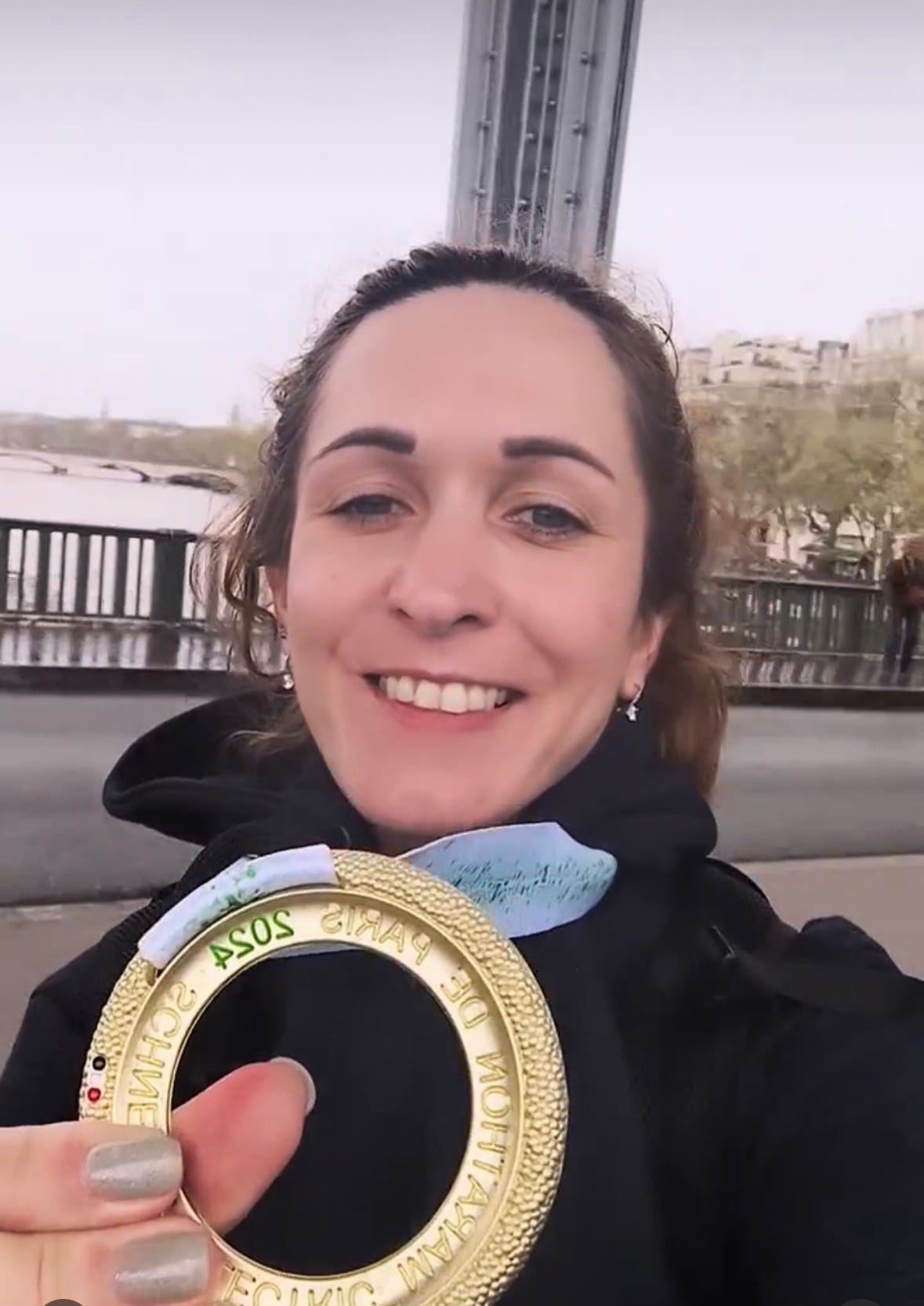
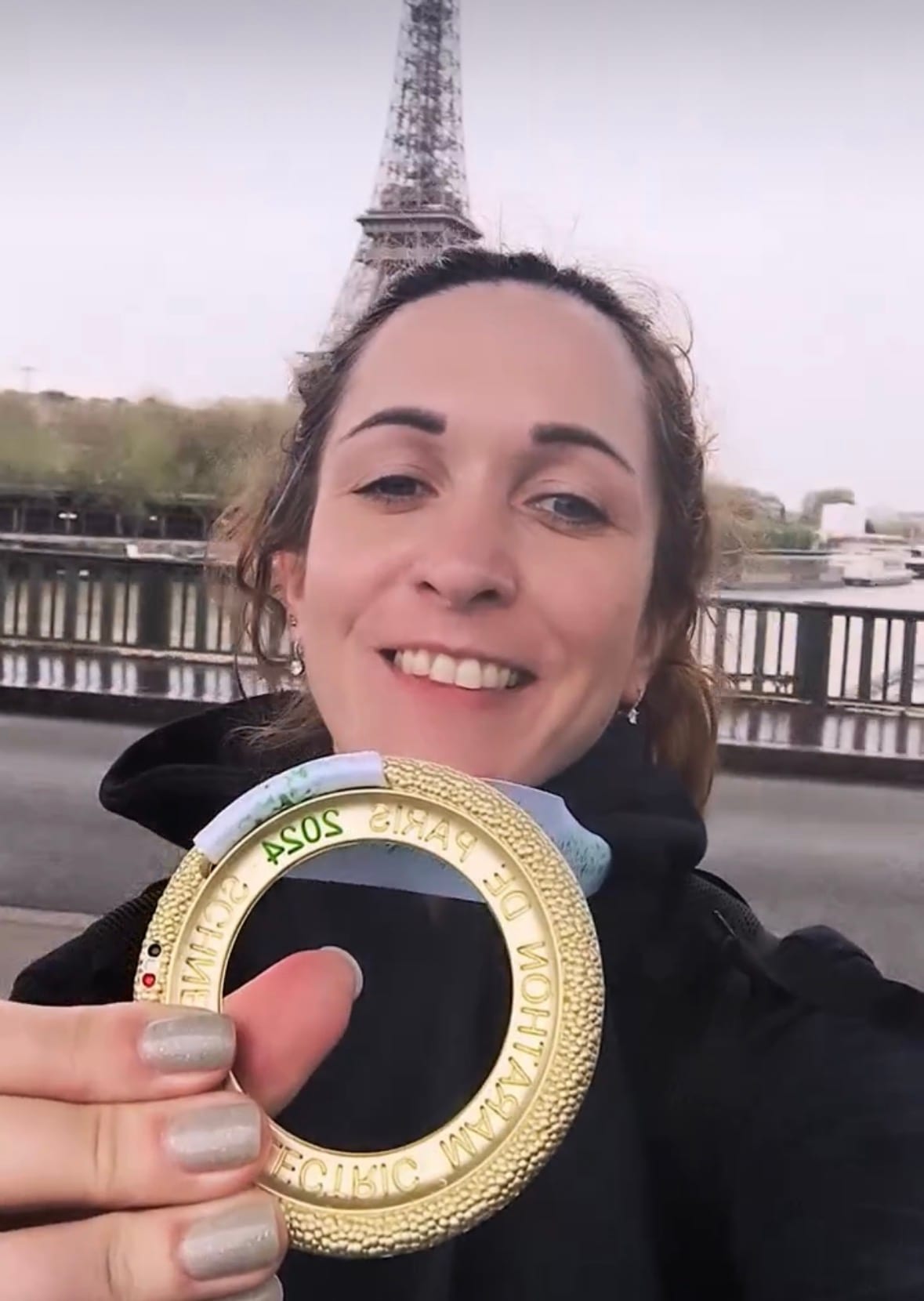
I do not remember exactly how I crossed the finish line. I remember the medal. I remember the grass. I remember lying down and crying, completely empty and at the same time filled with a feeling only a marathon can create - that strange combination of exhaustion and endless pride, when you know the distance broke you in many places but you still found a way to put enough of yourself back together to reach the end.
It was my slowest marathon. It was also the most exhausting, the hardest and the most emotional.
And that is precisely why it is my favourite.
I used to believe that the value of a race increased with speed, that the best marathon was the one where the watch showed a number that made us proud. Paris reminded me that some results cannot be measured by a watch: returning to your body after childbirth, the courage to set a goal again, the willingness to accept that you are no longer the same person who once ran 3:16, the support of a family who give you time to train, and the persistence to finally turn a third opportunity into reality.
To me, that medal says: you waited four years, became a mum, began again, doubted, feared, slowed down, walked, cried and still arrived.
That is why I wholeheartedly recommend the Paris Marathon to anyone who wants not only to see a city with their eyes but to feel it with their entire body, from the first excitement on the Champs-Élysées to the final painful step on Avenue Foch. The atmosphere, the music, the river of runners and the feeling as the Louvre, Bastille, the Seine, Notre-Dame and the Eiffel Tower pass beside you cannot be fully captured in words.
You have to experience it.
And if your road to that start is not straight, if plans change once, twice or more, do not immediately assume that life is telling you no. Perhaps it is only saying: not yet, because everything that arrives late is waiting for the version of us who will best understand the value of the moment when it finally comes true.
City and year
Paris, 2024
Distance
42.195 km
Course
Urban, rolling, through parks and along the Seine
City
Paris, France
Start
Champs-Élysées
Finish
Avenue Foch
Edition
7 April 2024
Participants
More than 53,000 finishers
Favorite moment
The finish with a view towards the Arc de Triomphe
Learn more about Aleksandra
KEEP THE STORY RUNNING
Link copied
Story gallery